

Start your own Muslim community
You do not need a building, a board or a budget. Create the community, publish the halaqa, charge a membership if you want to, take donations, run the classes, and keep every person who shows up on a list that belongs to you. Free, with unlimited members.
The group chat was never going to hold it.
Most Muslim communities start the same way. A few people, a weekly circle, a WhatsApp group. Then thirty people join and the announcement is buried under forty messages. Somebody collects money for the retreat on a payment app and reconciles it by hand. Nobody knows who is actually coming. The person who started it becomes an administrator by accident, and the thing they loved becomes admin.
The usual next step is to be pointed at a platform built for creators selling courses. That works, up to the moment you want to take a sadaqah, hand someone a receipt, run a term of classes with a sibling discount, or scan people in at the door. Those are not creator problems. They are the problems of a Muslim community, and they show up in month two.
Ummah is built for those problems and free to start with unlimited members. Not a trial. Not a seat cap. Not a plan you outgrow at forty people.
A list you own, not an audience you rent.
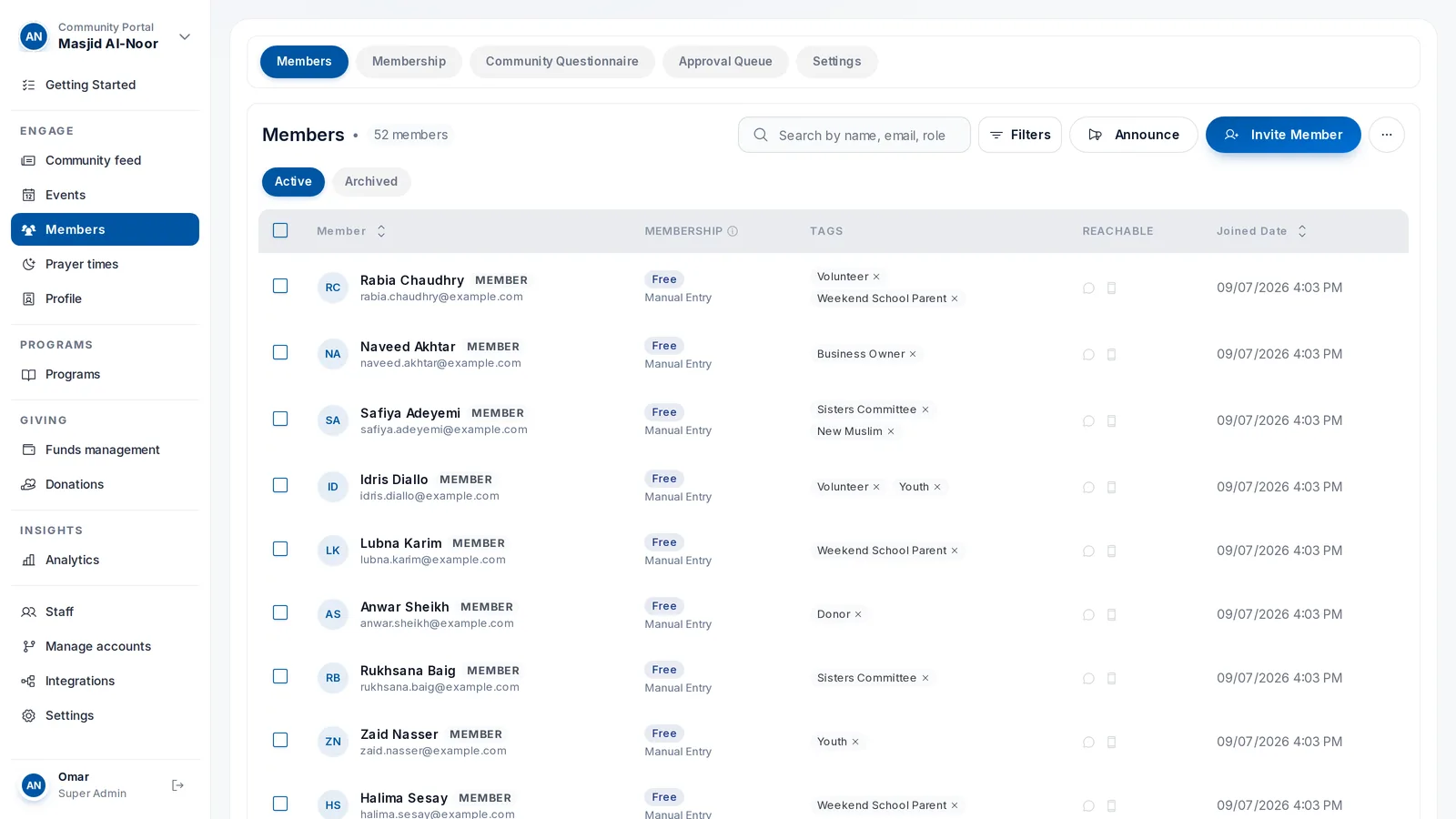
Everyone who registers for an event, enrolls in a class or donates becomes a member in your directory automatically. Tag them, group them into committees, filter them, and export the whole thing to CSV whenever you want. Reach them by email, push, in-app or text, all at once or by tag.
- Unlimited members on the free plan, with no seat cap and no per-admin charge
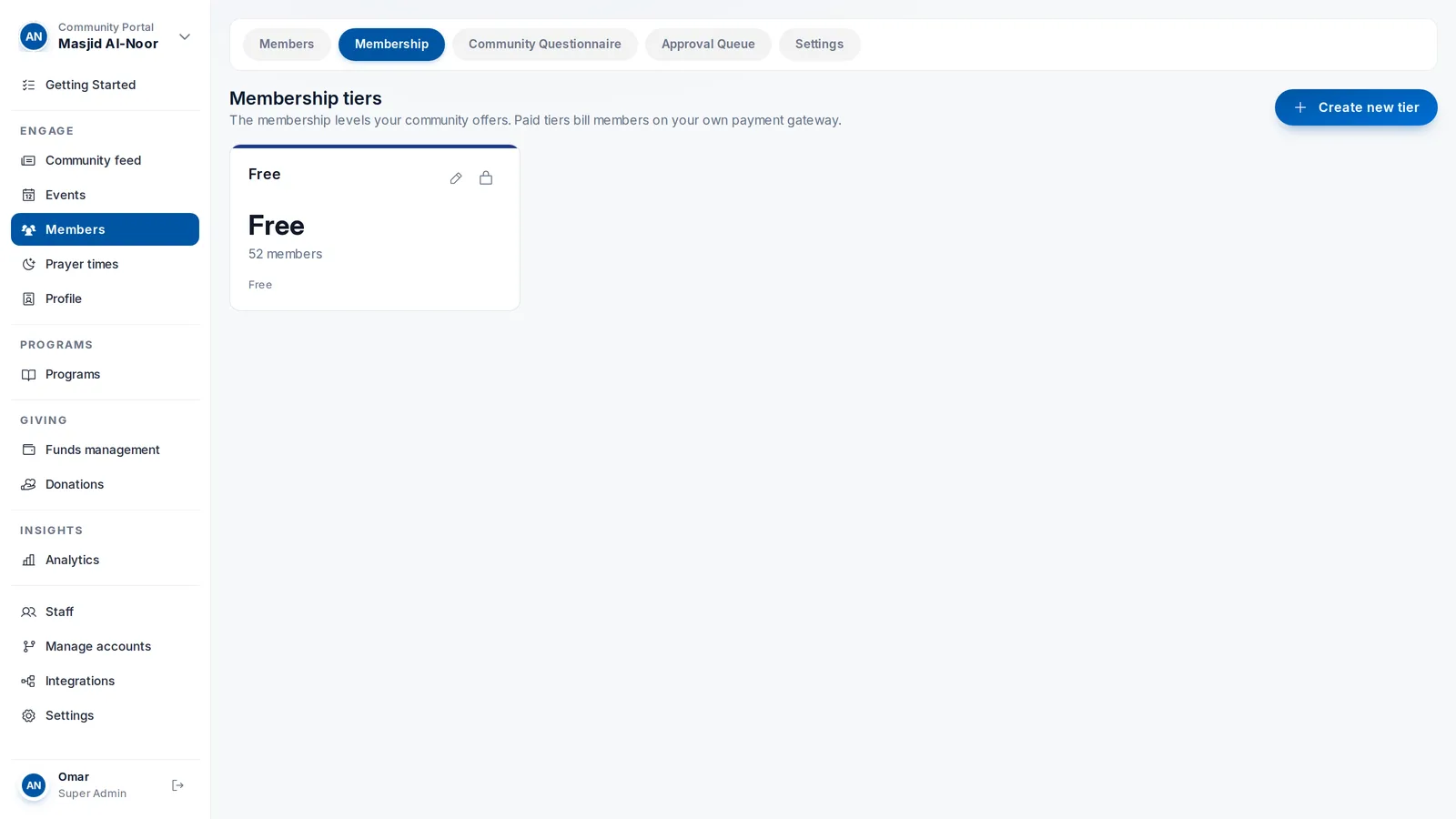
- Membership tiers you design, with monthly dues paid by card into your own Stripe
- An approval queue with your own questions, so you see who is asking before they are in
- A private moderated feed, so the announcement is not buried under forty messages
- Full CSV export, any time. If you ever leave, you leave with the list
Charge a membership. Take a donation. Sell a ticket. Keep the face value.
On Ummah the platform fee is added at checkout and paid by the person buying, so your organization receives the full amount you set. On the platforms usually recommended to you, the fee comes out of your payout instead.
- Membership tiers with monthly dues, joined and cancelled by members themselves
- Donation campaigns with goals, recurring giving, a donor directory and year-end tax receipts
- Paid tickets with multi-tier pricing, promo codes, a waitlist and QR check-in at the door
- Free events and free members cost nothing at all, on every plan
- 3% on Free, 1.5% on Basic, 0% on Advanced — paid by the buyer, not deducted from you
A weekly halaqa, a term of classes, an annual retreat.
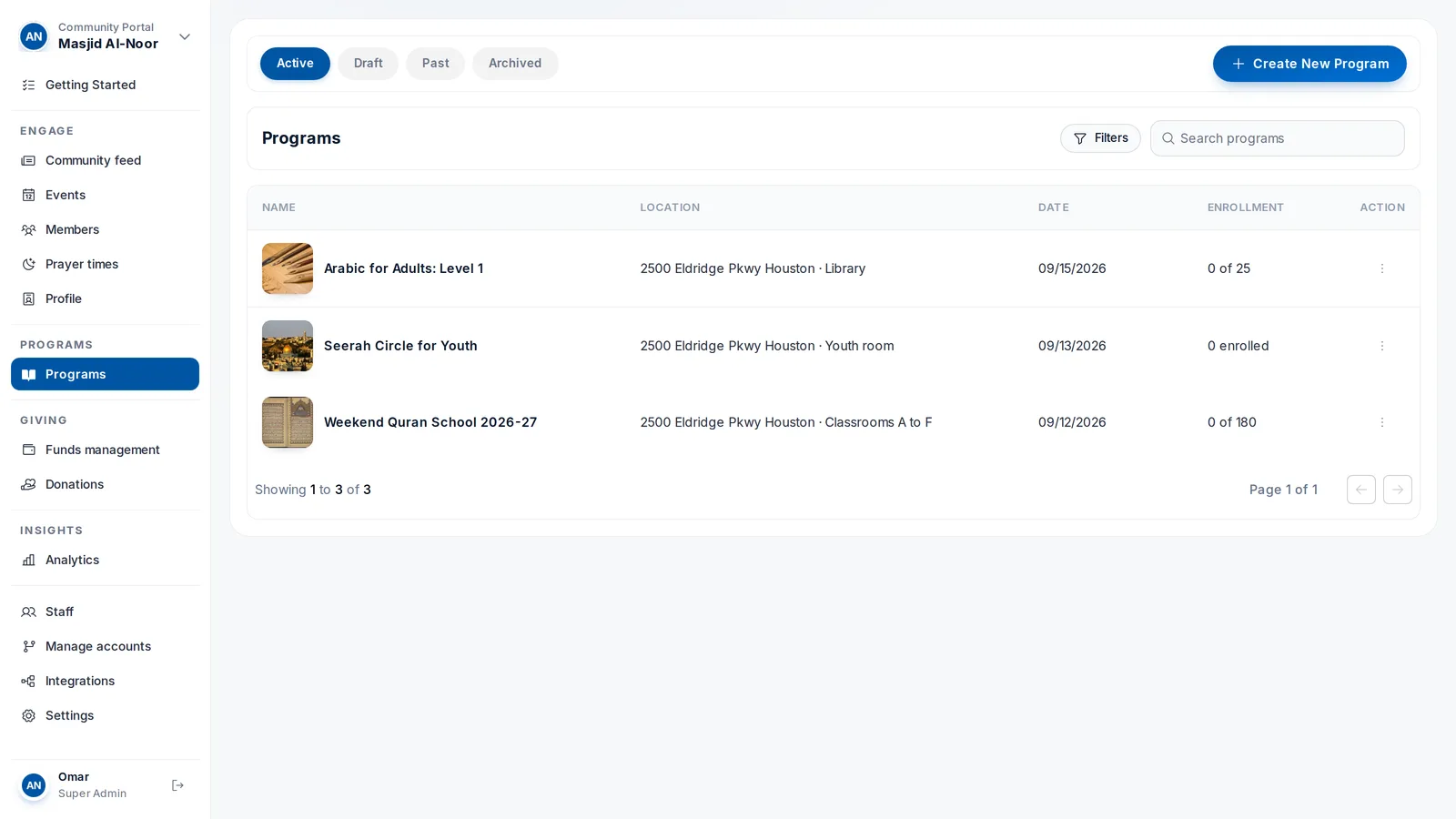
Events handle the one-off. Programs handle the term: a session per week, early-bird pricing that closes on a date, a payment plan so somebody can pay across three months, sibling discounts that apply themselves, a waitlist, and attendance per session.
- Recurring events for the weekly circle, with reminders that actually arrive
- Programs with sessions, rosters, attendance and refunds against a policy you set
- Custom registration forms, including parent and child fields for a children’s class
- Prayer times for the venue on every event page
- Embed your events, classes, donations and prayer times on your own website
Being told to use Skool or Circle?
They are good products and we say so on both comparison pages. The difference for a Muslim community is three-fold. Neither has a free plan — Skool starts at $9 a month, Circle at $89 a month billed annually. On both, the transaction fee comes out of your payout rather than being paid by the buyer; Skool’s own help centre shows a $9 membership paying out $8.40. And neither has donations, tax receipts, ticketing with door check-in, weekend school with family pricing, or prayer times. Read off their own pages on September 19, 2026 — both comparisons show their sources and print the rows where they beat us.